





- Google has publicly released “SynthID Detector” (synthid.com), an AI-generated content identification and verification tool to check for the presence of the image, video, and audio digital watermark “SynthID.”
- Users can simply upload files via a browser to the dedicated site “synthid.com” to check for the presence of “SynthID.”
- Supported formats are JPG, PNG, HEIC, and GIF for images; MP4, MOV, and WEBM for videos; and MP3, WAV, and FLAC for audio.
On Wednesday, October 7, 2026 local time, Google announced the public release of “SynthID Detector (synthid.com),” an AI-generated content identification and verification tool that checks for the presence of the image, video, and audio digital watermark “SynthID.”
“SynthID” is a technology developed by Google’s AI research division, Google DeepMind, which embeds imperceptible digital watermarks into AI-generated images, videos, and audio. Since its launch in 2023, it has been embedded in over 180 billion images and videos, and 240,000 years’ worth of audio.
“SynthID Detector” is an AI-generated content identification tool that originally appeared in May 2025 as an early version for journalists, media professionals, and researchers. By simply uploading files through a browser to the dedicated site “synthid.com,” users can check for the presence of “SynthID.”
The supported formats for “SynthID Detector” are JPG / PNG / HEIC / GIF for images, MP4 / MOV / WEBM for videos, and MP3 / WAV / FLAC for audio. Please note that signing in with a Google, OpenAI, or Apple account is required to use the service.
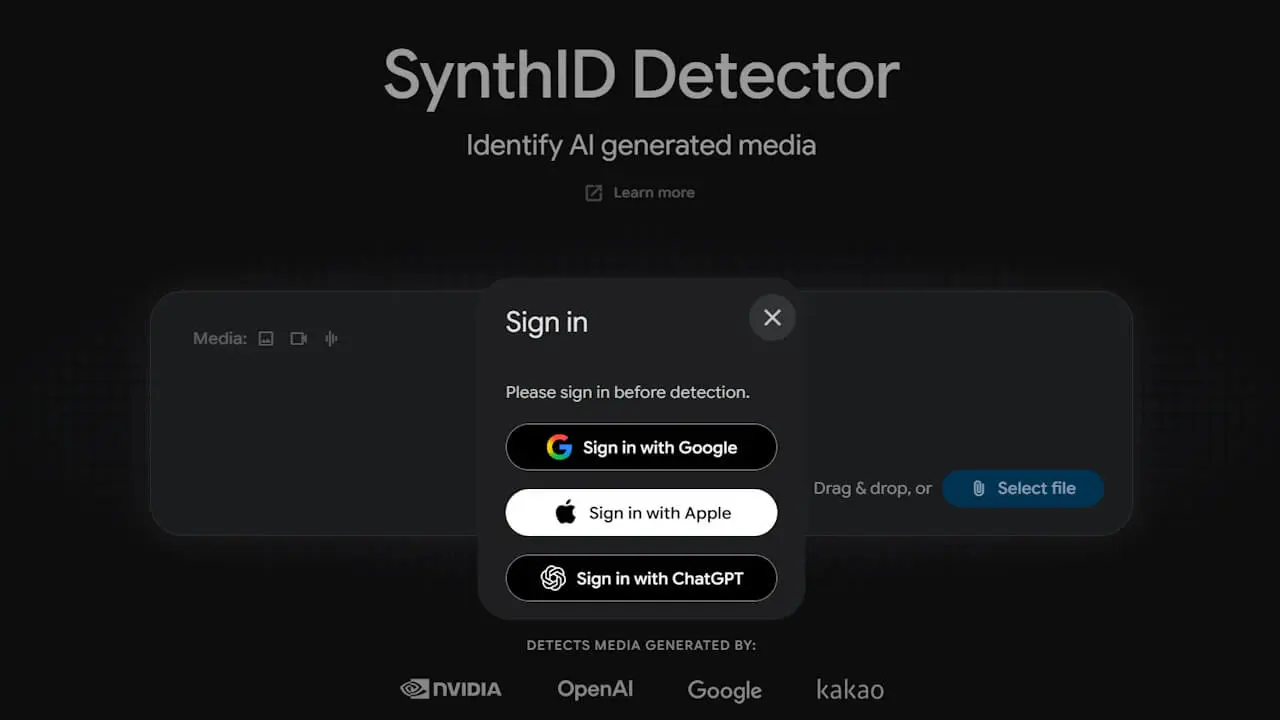
Content that can be identified by “SynthID Detector” includes creations from Google’s “Nano Banana,” “Veo,” and “Lyria,” as well as generative features in “Gemini,” “Flow,” and “Vids.” Additionally, it covers content created by AI from partners adopting “SynthID,” such as OpenAI, NVIDIA, and Kakao, with Apple expected to join soon.
“SynthID Detector” is currently available only in English, but it can be used worldwide, including in Japan.
Source: Google (https://blog.google/innovation-and-ai/models-and-research/google-deepmind/synth-id-ai-content/)