




- Google has released the beta OS update “Android 17 QPR2 Beta 5” for Google Pixel devices enrolled in the pre-release Android OS trial program, the “Android Beta Program.”
- Starting with “Android 17 QPR2 Beta 5,” the new generation Google Pixel devices (“Pixel 11,” “Pixel 11 Pro,” “Pixel 11 Pro XL,” and “Pixel 11 Pro Fold”) are now supported by the “Android Beta Program.”
- Includes a total of 8 bug fixes and improvements.
On Tuesday, September 15, 2026 local time, Google released the beta OS update “Android 17 QPR2 Beta 5” for Google Pixel devices enrolled in the pre-release Android OS trial program, the “Android Beta Program.”
“Android 17 QPR2,” which serves as the base for “Android 17 QPR2 Beta 5,” is the second set of updates following the first set of quarterly platform releases (QPR) known as “Android 17 QPR1,” which roll out quarterly after the official release of “Android 17.” Meanwhile, “Android 17 QPR2 Beta x” acts as the beta OS leading up to the official release.
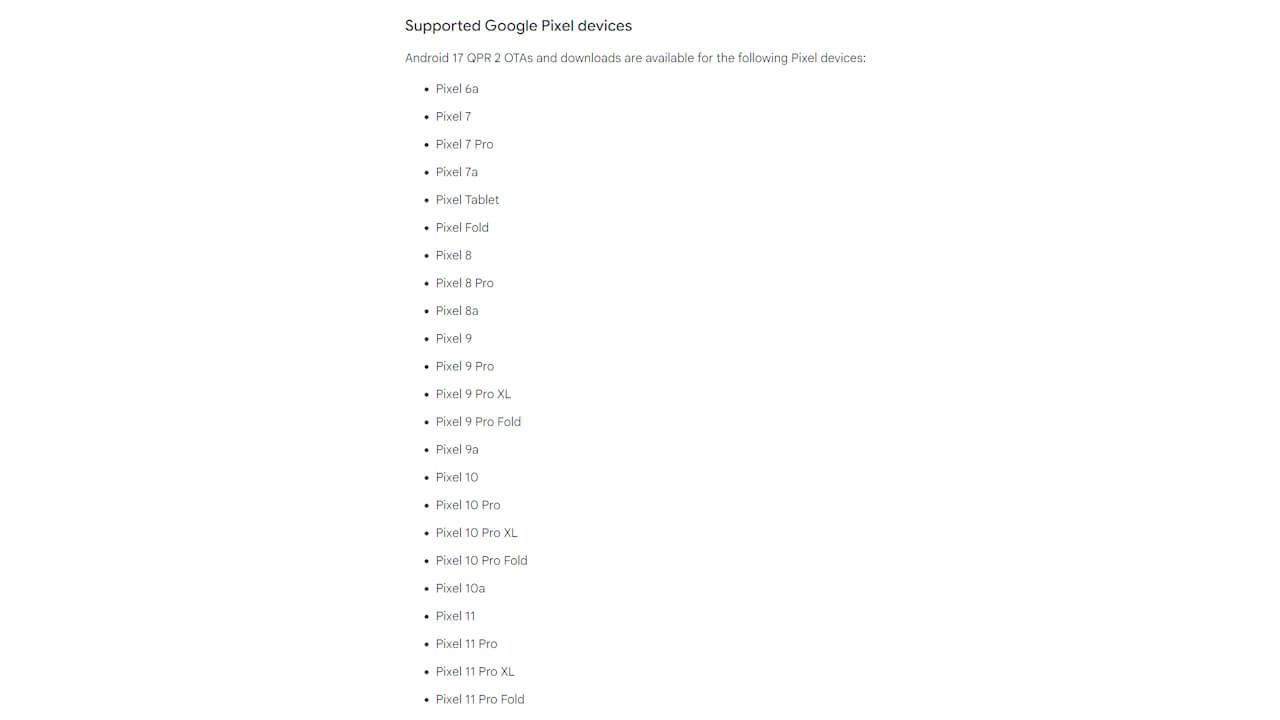
“Android 17 QPR2 Beta 5” is being delivered via Over-the-Air (OTA) software updates to a total of 23 models enrolled in the “Android Beta Program”: the “Pixel 6a,” “Pixel 7,” “Pixel 7 Pro,” “Pixel 7a,” “Pixel Fold,” “Pixel Tablet,” “Pixel 8,” “Pixel 8 Pro,” “Pixel 8a,” “Pixel 9,” “Pixel 9 Pro,” “Pixel 9 Pro XL,” “Pixel 9 Pro Fold,” “Pixel 9a,” “Pixel 10,” “Pixel 10 Pro,” “Pixel 10 Pro XL,” “Pixel 10 Pro Fold,” “Pixel 10a,” “Pixel 11,” “Pixel 11 Pro,” “Pixel 11 Pro XL,” and “Pixel 11 Pro Fold.” Starting with “Android 17 QPR2 Beta 5,” the next-generation Google Pixel devices—”Pixel 11,” “Pixel 11 Pro,” “Pixel 11 Pro XL,” and “Pixel 11 Pro Fold”—are now compatible with the “Android Beta Program.”


Note that starting with “Android 17 QPR2 Beta 1,” the “Pixel 6” and “Pixel 6 Pro” have been excluded from supported devices.

The biggest topic in this “Android 17 QPR2 Beta 5” release is the introduction of “Call Forwarding Hardening” aimed at preventing scam fraud. This feature analyzes and selectively restricts call-forwarding USSD codes (such as “*21#”) executed via the “TelephonyManager.sendUssdRequest()” API at the system level.
Specifically, calls to the “sendUssdRequest()” API from generic apps holding only the “CALL_PHONE” permission will become inaccessible. Any attempt to execute call-forwarding codes in the background will be blocked, returning a “USSD_ERROR_NOT_ALLOWED” callback. On the other hand, when users manually enter call-forwarding codes through the system dialer, a new OS-level confirmation dialog will appear before command execution to counter social engineering scams. Note that USSD requests that do not involve call forwarding, such as mobile money transfers or balance inquiries, are not affected by this change.
Apps affected by this change must properly handle the “USSD_ERROR_NOT_ALLOWED” failure callback. Additionally, for apps that require call-forwarding settings but do not qualify for an exemption role, it is recommended to transition to a flow where the number is pre-filled into the dialer using the “ACTION_DIAL” intent, leaving it to the user to manually confirm the action.
| ■ “Android 17 QPR2 Beta 5” Main Bug Fixes and Improvements |
|
After applying the “Android 17 QPR2 Beta 5” update, the build number will be updated to “CP41.260828.004.A8” or “CP41.260828.005.A6,” the Android security patch level will be “August 5, 2026,” and the “Google Play services” app will be updated to v26.28.33 or later.
| ■ Build Number |
|
| ■ Android Security Patch |
|
| ■ “Google Play services” App |
|
Source: Google (https://developer.android.com/about/versions/17/qpr2/release-notes#beta5)