




- Google has announced the research results for “AI-PPG-ACC-HTN,” a new AI system for detecting hypertension (high blood pressure) that utilizes standard sensors built into commercially available smartwatches such as the Google Pixel Watch.
- The “standard sensors” refer to two sensors equipped in typical smartwatches like the Google Pixel Watch series: the “optical heart rate sensor” and the “accelerometer.”
- The system works by accumulating and analyzing “pulse wave data” captured by the optical heart rate sensor along with “minute vibrations” captured simultaneously by the accelerometer over several days, calculating a risk score for sustained hypertension.
On Friday, November 6, 2026 (local time), Google announced the research results for “AI-PPG-ACC-HTN,” a new AI system that passively detects signs of hypertension (high blood pressure) in the background using standard sensors built into commercial smartwatches such as the Google Pixel Watch series.
Hypertension is often called a “silent killer” because it has almost no noticeable symptoms, affecting over one billion people worldwide. However, more than half of adult patients are unaware that they have high blood pressure. A major challenge has been that younger generations, particularly those aged 18 to 44, easily miss opportunities for health checkups, leading to delayed detection.
Blood pressure monitoring features on commercial smartwatches have traditionally required periodic manual calibration using a dedicated cuff-style blood pressure monitor, creating a high barrier to easily measuring blood pressure with a smartwatch alone. However, the greatest feature of the new system developed by Google, “AI-PPG-ACC-HTN,” is that it completely eliminates the need for prior calibration using a cuff-style monitor.
The “standard sensors of commercial smartwatches” mentioned here do not refer to special additional medical devices. Instead, they refer to two sensors already built into typical smartwatches like the Google Pixel Watch series: the “optical heart rate sensor,” which shines green or other lights onto the skin to read changes in blood vessel volume and pulse wave shapes, and the “accelerometer,” which detects arm movement and stationary states. The newly announced AI system, “AI-PPG-ACC-HTN,” accumulates and analyzes “pulse wave data”—changes in blood flow traveling through blood vessels when blood is pumped into the aorta with each heartbeat, captured by the optical heart rate sensor—along with extremely subtle “minute vibrations” transmitted to the surface of the skin on the wrist, captured simultaneously by the accelerometer over several days, to calculate a risk score for sustained hypertension.
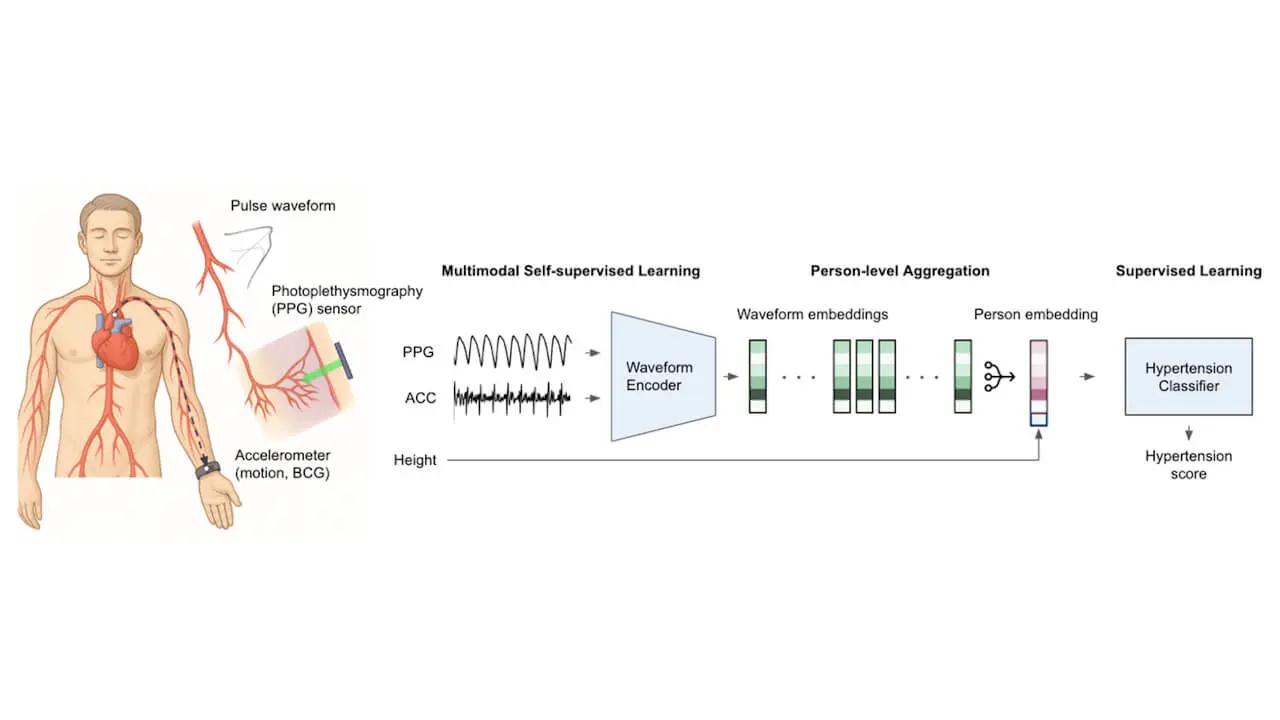
This new AI system, “AI-PPG-ACC-HTN,” makes it possible to detect signs of hypertension even with commercial smartwatches equipped with an optical heart rate sensor and an accelerometer. In fact, in a clinical trial involving 196 participants with no history of cardiovascular disease, when validated against a 24-hour ambulatory blood pressure monitor (ABPM) worn in a hospital as a benchmark, the system achieved a sensitivity of 65.8% and a positive predictive value of 80.6%, outperforming standard medical consultations and measurements at healthcare facilities (sensitivity 55.3% / positive predictive value 77.8%).
These research findings will also contribute to the development of the “Vascular Stress Level” feature within “Health Guardian,” a suite of health and safety features in the Google Health app where AI tracks subtle changes in the body in the background that are usually difficult to notice. Google will continue conducting various studies and validations to update health and safety features like “Health Guardian.”
Source: Google (https://research.google/blog/detecting-signs-of-hypertension-using-wearable-sensors/)