





- Google has announced major market liberalization measures concerning new security requirements for the Android platform, along with updates to app distribution and payment systems.
- These changes are critical for both the past and future of the Android ecosystem.
- Identity verification requirements for app developers will be significantly tightened to protect users from malicious malware and phishing scams.
On Thursday, March 19, 2026, Google announced new security requirements for the Android platform and major market liberalization measures regarding app distribution and payment systems.
The measures announced address long-standing criticisms regarding Google’s monopolistic structure on the Android platform. They aim to broaden choices for developers and users while thoroughly containing the associated security risks at the system level. This marks a pivotal moment for the past and future of the Android ecosystem.
First, to protect users from malicious malware and phishing scams, identity verification requirements for app developers will be significantly tightened. Specifically, starting in late 2026, apps from developers who have not completed identity verification will be automatically blocked by the system from being installed on standard Android devices.
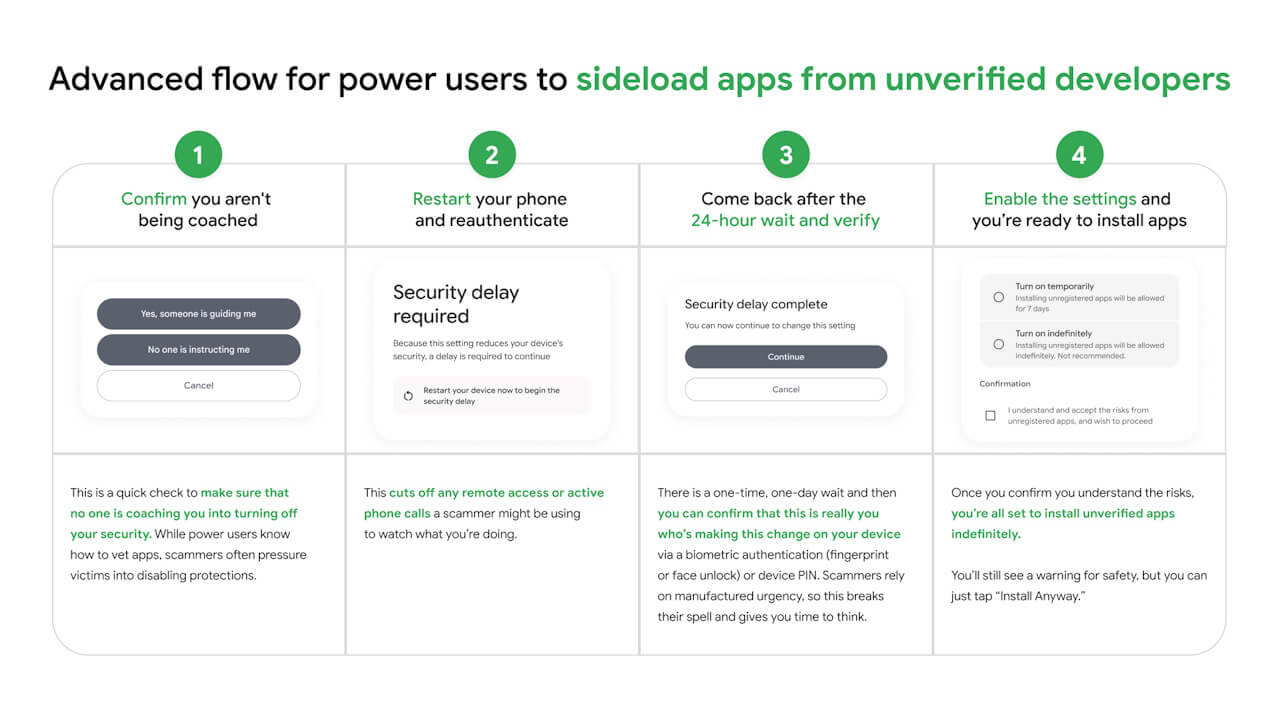
Even if a user intentionally attempts to install an app from a developer who has not completed identity verification, the system will enforce a “protection waiting period.” This requires enabling “Developer Options” and then waiting 24 hours before installation can proceed. Even after this 24-hour waiting period, biometric authentication will still be required.
The process leading up to the “protection waiting period” involves multiple confirmation steps after turning on “Developer Options,” as well as requiring an Android device restart and re-authentication. In other words, layers of protection are in place to prevent fraud before the waiting period even begins—such as preventing remote control of the Android device by scammers or requiring the disconnection of active calls.
Once the 24-hour “protection waiting period” has passed and biometric authentication is cleared, users will be able to choose whether to permit the installation of apps from unverified developers for a limited period of 7 days or indefinitely.
Furthermore, to ensure that hobbyist developers and students are not hindered by these stricter verification requirements, Google is introducing a new “Limited Distribution Account.” This allows for the deployment of up to 20 devices without the need for personal identification documents or registration fees. These measures for the Android platform are scheduled to begin in August 2026, prior to the official enforcement of the new developer verification requirements.
 jetstream.blog
Incidentally, Google has already announced the “Registered App Store Program,” which allows vetted app developers and businesses to implement their own in-app payment systems outside of “Google Play” or direct users to external websites for payments, providing greater flexibility. Today’s announcement adds a layer of significantly tightened developer identity verification on top of these existing policies.
Source:Google